
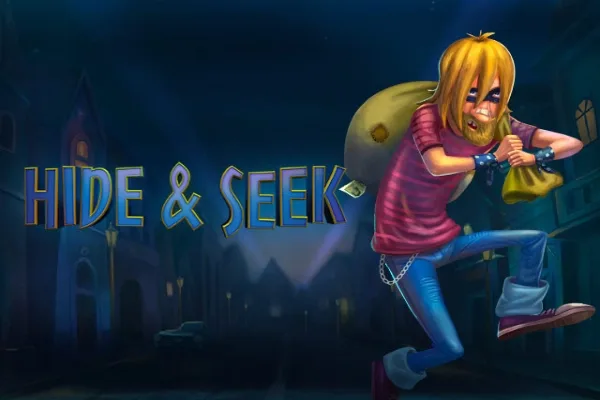
Hide & Seek
Game Parameters
Game Guide
 1 Reel – Castle of the Beast: Bonus Features & Mechanics
 How to Play 1 Reel – Candy Spins: Betting & Win Mechanics
 1 Reel – Candy Spins: Features & Bonus Mechanics Explained
About Hide & Seek
Hide & Seek is a universally recognized game with origins tracing back to ancient times, played across diverse cultures. Its visual premise is simple: one player counts while others find places to conceal themselves. The art direction is entirely player-driven, relying on the environment and the creativity of participants to establish hiding spots and search patterns. This traditional game fosters interaction and imaginative play, making it a staple of childhood recreation worldwide. It encourages both physical activity and strategic thinking, adapting to various settings from backyards to parks. The game's enduring appeal lies in its accessibility and the endless possibilities for creative engagement.
Game Highlights
- Engages creativity and imagination for hiding spots.
- Promotes physical activity and exploration.
- Develops strategic thinking and observation skills.
- Offers simple, accessible fun without complex equipment.
RTP & Betting Snapshot
See what this RTP figure means across simple ₱10-per-spin theoretical wagering examples.
| Spins | Total Wagered | Theoretical Return | Theoretical House Edge |
|---|---|---|---|
| 100 | ₱1,000 | ₱960 | ₱40 |
| 500 | ₱5,000 | ₱4,800 | ₱200 |
| 1,000 | ₱10,000 | ₱9,600 | ₱400 |
Important: Theoretical return is a long-run mathematical estimate, not a prediction of your actual result after 100, 500, or 1,000 spins. RTP does not tell you when a win, bonus, jackpot or maximum win will occur.
Gameplay, Features & Editorial Guide
Core Features
The Seeker's Count
One player closes their eyes and counts to a predetermined number, typically 10 or 20, providing time for others to hide. This establishes the start of the search phase.
Strategic Hiding
Other players discretely position themselves within the designated play area, aiming for concealment that is both effective and challenging for the seeker to discover.
The Search and Discovery
After counting, the seeker opens their eyes and actively searches for the hidden players. The goal is to locate and identify each hider.
Calling Out and Tagging
Upon finding a hider, the seeker typically calls out their name and the location where they were found. Depending on the rules, the hider may be 'caught' or need to be tagged.
Gameplay & Mechanics
- 1
Choose Seeker and Count
One player is chosen as the seeker, who then closes their eyes at a designated 'base' and counts aloud to a set number, allowing others to hide.
- 2
Hide Strategically
Other players find suitable hiding spots within the agreed-upon boundaries, aiming for concealment without being easily discovered.
- 3
Seek and Discover
After counting, the seeker opens their eyes and begins actively searching for the hidden players, exploring the play area.
- 4
Tag or Call Out
When a hider is found, the seeker typically calls out their name and location, then races back to the base to 'tag' them, effectively catching them.
- 5
End Round and Reset
The round concludes when all hiders are found or a time limit is reached, and a new seeker is chosen for the next game.
Pros
- Encourages physical activity and outdoor play.
- Develops problem-solving and strategic thinking.
- Promotes social interaction and cooperation.
- Requires no special equipment, making it highly accessible.
Cons
- Requires a suitable play area with ample hiding spots.
- Can be less engaging for very small groups.
- Potential for arguments over rules or unfair hiding.
- Risk of minor injuries if played in unsafe environments.
Best For
- Players who enjoy active, outdoor games.
- Groups looking for simple, engaging social activities.
- Children developing spatial awareness and strategic skills.
- Families seeking a classic game that requires no setup.
What to Know Before Playing
These notes explain verified game characteristics and responsible play considerations. They do not change the game RTP or guarantee a result.
Low Budget
Focus on finding the most obscure and unexpected hiding spots, even if they are uncomfortable. For seekers, systematically search areas rather than randomly wandering.
Balanced Play
As a hider, balance deep concealment with proximity to the 'base' if 'tagging' is part of the rules. As a seeker, listen carefully for sounds and observe subtle environmental changes.
High Budget
For hiders, utilize misdirection by creating false trails or making small noises away from your actual location. Seekers can employ advanced search patterns, dividing the area logically.
Hide & Seek FAQ
What is the primary objective of Hide & Seek?
The primary objective of Hide & Seek is for one player, the 'seeker,' to find all the other players, the 'hiders,' who have concealed themselves within a designated area. The hiders' objective is to remain undiscovered until the game ends or a specific condition is met.
Are there different versions or rules for Hide & Seek?
Yes, various versions and house rules exist. Common variations include 'Sardines,' where one person hides and everyone else searches, joining the hider once found, or adding a 'base' that hiders must reach to be safe after being found.
What skills are enhanced by playing Hide & Seek?
Playing Hide & Seek can enhance several skills, including strategic thinking, problem-solving, spatial awareness, patience, and observation. Hiders learn to assess their environment for optimal concealment, while seekers develop keen observational skills.
Is Hide & Seek suitable for all ages?
Hide & Seek is generally suitable for a wide range of ages. Younger children enjoy the simple thrill of hiding and being found, while older players can introduce more complex strategies and larger play areas, making it adaptable for different age groups.
What information is available about Hide & Seek?
This page combines verified source data with clearly labelled editorial guidance. Unsupported facts are left unavailable rather than estimated.