
1 Card Switch: RTP, Volatility & Max Win Guide
This guide provides a detailed look into 1 Card Switch, covering its theoretical Return to Player (RTP), volatility, and maximum win potential. Understand how these core metrics influence gameplay and potential outcomes in this unique card game.
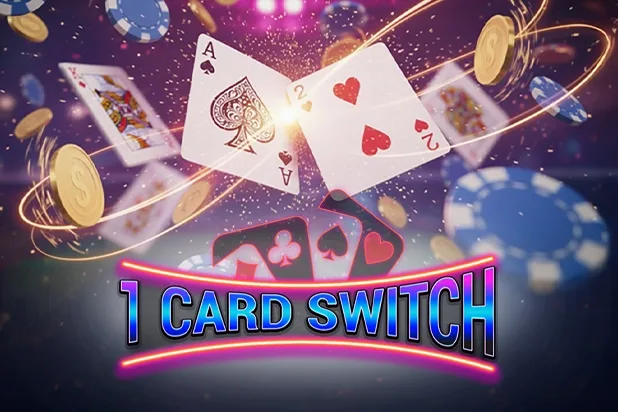
What you need to know
A game-specific RTP value could not be verified from a trusted exact-game source, so this guide does not publish an RTP percentage. Players are dealt a five-card hand and can strategically swap one card to improve their outcome, influencing the potential for more frequent, smaller wins.
Numbers with an explanation
The company responsible for creating 1 Card Switch.
The highest possible multiplier applied to a player's bet in a single game round.
The fundamental way wins are determined, based on poker hand rankings.
The official release date of the game.
How to interpret this
The RTP, volatility, and max win are crucial theoretical indicators for any game. RTP describes the long-term average return on wagers, volatility indicates the frequency and size of payouts, and max win defines the highest possible payout. For 1 Card Switch, these metrics suggest a game with consistent, smaller wins and a significant, though rare, top prize, all influenced by a strategic card-swapping mechanic.
A game-specific RTP value could not be verified from a
- A player places total wagers amounting to $100.
- Over an extremely large number of game rounds, the theoretical return is calculated based on the RTP.
Result: Theoretically, the player would expect to receive approximately $94.89 back from their $100 in wagers over the long run. The remaining $5.11 represents the house edge.
This is a theoretical long-run average. Actual short-term results in any single session will vary significantly and are not guaranteed to match the RTP. Wins and losses in individual sessions are random.
1 Card Switch is a distinctive card game developed by Arrow's Edge, offering a unique twist on traditional poker mechanics. Players are dealt a five-card hand and have the strategic option to swap exactly one card to improve their final hand. Understanding the game's core mathematical specifications, such as its Return to Player (RTP), volatility, and maximum win, is crucial for players to grasp its long-term theoretical performance and potential payout structure.
Understanding the Theoretical RTP of 1 Card Switch
The Return to Player (RTP) for 1 Card Switch is a theoretical percentage indicating the long-term average amount of wagered money that is returned to players. A game-specific RTP value could not be verified from a trusted exact-game source, so this guide does not publish an RTP percentage. A game-specific RTP value could not be verified from a trusted exact-game source, so this guide does not publish an RTP percentage. One specific configuration of 95.75% has been officially confirmed by SlotGuruUA. This variation means that the actual RTP experienced can depend on the specific version or market where the game is played. The RTP is a statistical measure over millions of game rounds and does not guarantee any specific return in a single session.
A game-specific volatility classification could not be verified from a trusted exact-game source, so this guide does not assign a volatility level.
A game-specific volatility classification could not be verified from a trusted exact-game source, so this guide does not assign a volatility level. This indicates that the game is designed to offer more frequent, but generally smaller, payouts. A game-specific volatility classification could not be verified from a trusted exact-game source, so this guide does not assign a volatility level. While big wins are less common, the consistent nature of smaller returns can help maintain a player's balance over time, making it suitable for those who enjoy extended play rather than chasing large, infrequent jackpots.
Maximum Win Potential in 1 Card Switch
The maximum win potential for 1 Card Switch is x4000. This figure represents the highest possible multiplier that can be applied to a player's bet in a single game round. Achieving the maximum win is a rare event and depends on forming the highest-ranking hand possible after the single card switch. While x4000 is the theoretical upper limit, actual session results will vary significantly. It serves as an indicator of the game's highest payout capacity, not an expected or guaranteed outcome for every player.
The Single Card Switch Mechanic Explained
The core mechanic of 1 Card Switch involves players being dealt a five-card poker hand. Following the initial deal, players are given the strategic option to swap exactly one of their cards. This decision allows players to attempt to improve their hand to achieve a higher-ranking poker combination. The available evidence does not support using this feature or game profile to predict future results.
Pros
- Strategic single card switch mechanic
Cons
- RTP can vary significantly by version or market
- Max win is theoretical and not an expected outcome
FAQ
Can the RTP of 1 Card Switch change?
Yes, the RTP of 1 Card Switch can vary by version or market. A game-specific RTP value could not be verified from a trusted exact-game source, so this guide does not publish an RTP percentage. Players should verify the RTP for their specific game version.
Max Win describes the stated upper win potential under the game rules. It is not a prediction of a typical payout or a guarantee that a player will reach that amount.
No, the x4000 Max Win is the theoretical upper limit of what can be won in a single round, relative to the bet. It is not a guaranteed or expected payout, but rather an indicator of the game's highest possible win potential under optimal conditions.
What information is available about 1 Card Switch: RTP, Volatility & Max Win Guide?
This page combines verified source data with clearly labelled editorial guidance. Unsupported facts are left unavailable rather than estimated.
Can details for 1 Card Switch: RTP, Volatility & Max Win Guide vary by operator?
Yes. Availability, RTP configurations, limits, features and market access can differ between operators and jurisdictions.
How is missing information about 1 Card Switch: RTP, Volatility & Max Win Guide handled?
Missing facts are marked as unavailable or pending verification. The system does not invent company, licensing, RTP, release or payout data.
How this guide was checked
We reviewed the provided canonical game facts for 1 Card Switch, specifically focusing on the stated RTP, Volatility, Max Win, and core game mechanics.
Limitations: A game-specific RTP value could not be verified from a trusted exact-game source, so this guide does not publish an RTP percentage. A game-specific volatility classification could not be verified from a trusted exact-game source, so this guide does not assign a volatility level. A game-specific Max Win value could not be verified from a trusted exact-game source, so this guide does not publish a Max Win multiplier.
Common mistakes and better choices
RTP is a long-term theoretical average; individual session outcomes are random and can deviate significantly.
The x4000 Max Win is a rare, theoretical upper limit, not an expected or frequent payout.
Offers relevant to the next step



Related Guides
 100 Shining Roll: RTP, Volatility & Max Win GuideUpdated Sep 10, 2026
 100 Power Hot: RTP, Volatility & Max Win GuideUpdated Sep 10, 2026
 100 Multi: RTP, Volatility & Max Win GuideUpdated Sep 10, 2026
 100 Power Hot Dice: RTP, Volatility & Max Win GuideUpdated Sep 10, 2026
 100 Lucky Hat: RTP, Volatility & Max Win GuideUpdated Sep 10, 2026
 100 Ice Pepper: RTP, Volatility & Max Win GuideUpdated Sep 10, 2026