
RTP (Return to Player) Explained
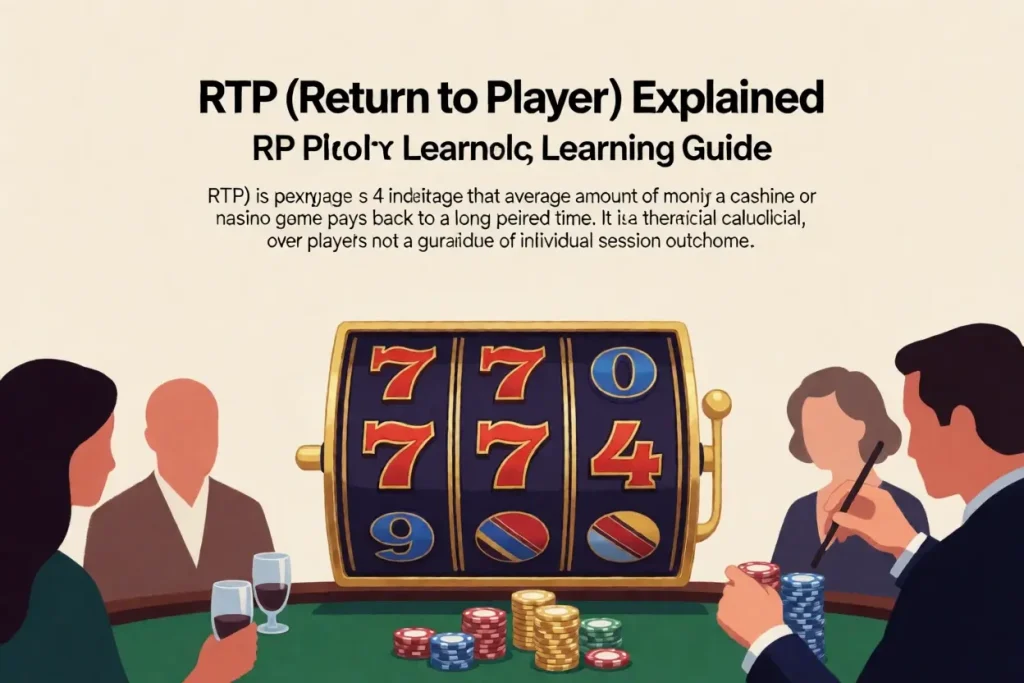
Return to Player (RTP) is a percentage indicating the theoretical average amount a casino game pays back to players over extended play. It's a long-term calculation, not a guarantee of individual session results.
What you need to know
RTP (Return to Player) is a theoretical percentage representing the average amount a casino game pays back to players over an extremely large number of plays. It indicates the game's long-term generosity, with the remaining percentage being the house edge.
Numbers with an explanation
This is a common benchmark for what is considered a good RTP for online slot machines. Many games fall around this figure.
For a game with 96% RTP, the theoretical house edge is 4%, meaning the casino expects to retain 4 units for every 100 units wagered over
How to interpret this
RTP provides players with a statistical understanding of a game's theoretical payout structure. It's a crucial metric for comparing games and making informed decisions, but it should not be mistaken for a guarantee of individual session returns. The actual returns in any single session can vary significantly due to the game's inherent randomness and volatility. Understanding RTP helps manage expectations and promotes a more informed approach to casino gaming.
Theoretical RTP Wager Example
- Calculate the expected theoretical return to players: 1,000 units * 96% = 960 units.
- Calculate the theoretical house edge (casino's expected retention): 1,000 units * (100% - 96%) = 40 units.
Result: Over 1,000 units theoretically wagered across all players, the game is expected to return 960 units to players, with the casino retaining 40 units as its theoretical house edge.
This example illustrates the long-run theoretical average. Individual play sessions will vary significantly due to randomness and volatility. A player could win much more or lose much more than this average in a short period.
RTP vs. Volatility
| Factor | RTP (Return to Player) | Volatility (Variance) | What it means |
|---|---|---|---|
| What it measures | Long-term theoretical payout percentage | Frequency and size of payouts | RTP tells you 'how much' is theoretically returned, while Volatility tells you 'how often and how big' those returns might be. |
| Impact on session | Influences theoretical long-term potential | Determines short-term bankroll swings and excitement | High RTP suggests better theoretical value over time, but high volatility means you might experience significant ups and downs in a single session. |
| Player preference | Higher is generally preferred for theoretical value | Low for consistent small wins, High for infrequent large wins | Players choose RTP for theoretical fairness, but volatility for their preferred risk level and playstyle. |
Return to Player (RTP) is a fundamental concept in understanding casino games, particularly slot machines, table games, and video poker. It represents the long-term theoretical payout percentage of a game, calculated over millions, or even billions, of simulated game rounds. While it doesn't predict short-term results for any single player or session, it offers crucial insight into the game's generosity and the casino's theoretical advantage (house edge) over an extended period of play. For players, grasping RTP is key to making informed decisions about which games align with their expectations for theoretical returns and understanding the inherent statistical nature of casino entertainment.
What is Return to Player (RTP)?
RTP, or Return to Player, is expressed as a percentage, typically ranging from 90% to 99%. For example, a game advertised with a 96% RTP means that, on average, for every 100 units of currency wagered by all players combined over its lifetime, the game is expected to return 96 units to players. The remaining percentage, in this case, 4%, represents the house edge, which is the casino's theoretical profit margin over the same vast number of plays. It's vital to understand that this is a statistical average and not a promise of what any single player will experience in a short session. Individual outcomes are subject to randomness and can vary significantly from this theoretical average.
How RTP is Calculated and Verified
RTP is meticulously determined by the game's mathematical model, which includes its rules, paytable, and the probabilities governed by its Random Number Generator (RNG). This calculation is not based on actual player results but on a vast number of simulated game outcomes, often running into billions. Game developers perform these calculations during the design phase. Before games are released, independent testing agencies, such as eCOGRA, GLI, or iTech Labs, audit and certify the RTP to ensure fairness, accuracy, and compliance with regulatory standards. This verification process ensures that the stated RTP is mathematically sound and that the game operates as intended. It's important to note that RTP can sometimes vary by game version or jurisdiction, so players should always verify the specific RTP for the game they are playing.
RTP vs. Volatility: Understanding the Difference
While RTP indicates the long-term theoretical payout, it does not tell you about the frequency or size of wins within that payout. This is where volatility (also known as variance or risk) comes into play. A high RTP game can have high volatility, meaning it might pay out less frequently but with the potential for larger wins, leading to more significant swings in a player's bankroll. Conversely, a high RTP game could have low volatility, meaning it pays out more frequently but with smaller wins, offering a more consistent but less dramatic playing experience. Both RTP and volatility are crucial factors to consider when choosing a game, as they describe different, yet equally important, aspects of a game's payout behavior and impact your session experience.
Why Understanding RTP is Important for Players
Understanding RTP helps players make informed decisions about which games to play, aligning their choices with their preferences and bankroll management strategies. Games with higher RTP percentages theoretically offer a better long-term return to the player, meaning the house edge is smaller. While this doesn't guarantee wins, it suggests a more favorable statistical position over an extended period. For instance, a player looking for longer play sessions with less risk might prefer a high RTP, low volatility game. Conversely, a player seeking the thrill of potentially large wins, even with higher risk, might opt for a high RTP, high volatility game. It's crucial to remember that RTP is a theoretical average over an extensive period and does not guarantee specific outcomes for any single playing session.
RTP Across Different Casino Game Types
RTP values can vary significantly depending on the type of casino game. For slot machines, RTP typically ranges from 90% to 98%, with online slots generally offering higher percentages than land-based counterparts. Table games like Blackjack or Video Poker, when played with optimal strategy, can often boast some of the highest RTPs, sometimes exceeding 99%. This is because player decisions can influence the outcome, unlike slots where outcomes are purely random. Roulette, on the other hand, usually has a fixed RTP based on its wheel layout (e.g., European Roulette with a single zero typically has a higher RTP than American Roulette with a double zero). Understanding these differences helps players choose games that align with their preferred level of theoretical return and engagement.
Pros
- Provides insight into a game's long-term theoretical payout potential
- Helps players compare the theoretical generosity of different games
- Indicates the theoretical house edge of a game
- Aids in making informed game selection decisions
Cons
- Does not guarantee individual session outcomes or short-term wins
- Does not account for game volatility, which impacts win frequency and size
- Is a theoretical average over millions of plays, not a prediction for a single player
- Can vary by game version, operator, or jurisdiction
FAQ
Does a high RTP guarantee I will win?
No, a high RTP does not guarantee individual wins or profits in any single session. It is a theoretical average calculated over millions of game rounds and does not predict short-term results for any single playing session. Randomness and volatility mean you can still experience losses even on high RTP games.
What is considered a good RTP percentage for online slots?
Generally, an RTP of 96% or higher is considered good for online slot games. Many modern online slots offer RTPs between 96% and 97.5%. However, what is 'good' can vary depending on the game type, specific features, and a player's preference for volatility.
Where can I find a game's RTP?
Most reputable online casinos and game developers prominently display the RTP for their games. You can usually find this information within the game's information section, paytable, rules menu, or sometimes on the game provider's website. Always verify this information directly from the source.
Can RTP change over time or between casinos?
Yes, RTP can sometimes vary by game version, operator, or market jurisdiction. Some game providers offer different RTP settings for their games, which casinos can choose from. It is always advisable to check the specific RTP for the exact game version you are playing at your chosen operator to ensure you have the most accurate information.
Is a higher RTP always better?
From a purely statistical, long-term perspective, a higher RTP is theoretically better as it means a lower house edge. However, a higher RTP doesn't necessarily mean a more enjoyable game for every player. Factors like volatility, bonus features, theme, and personal preference also play a significant role in a player's experience. A game with a slightly lower RTP but exciting features might be preferred by some.
Common mistakes and better choices
RTP is a theoretical long-term average over millions of plays. Short-term results are random and can deviate significantly from this average due to chance.
Low volatility generally means payout outcomes tend to be less uneven; it does not by itself guarantee a higher win frequency or any win.
Always verify the specific RTP for the exact game version you are playing at your chosen casino, as it can sometimes vary by market or operator
Games connected to this topic

1524 Golden Quest
Neko Games
- RTP
- 95.04%
- Volatility
- High
- Max Win
- 5,000x

15 Coins Xmas
Wazdan
- RTP
- 96.07%
- Volatility
- —
- Max Win
- —

15 Coins Love the Jackpot
Wazdan
- RTP
- —
- Volatility
- —
- Max Win
- —

16 Coins
Wazdan
- RTP
- 96.18%
- Volatility
- High
- Max Win
- —
Offers relevant to the next step



Related Guides
 Casino Slot RTP and Volatility ExplainedUpdated Aug 25, 2026
 Read More vs Similar Slots: Features, RTP and Volatility ComparedUpdated Aug 25, 2026
 Max Win Machine RTP Explained: What the Percentage Means for PlayersUpdated Aug 25, 2026
 How to Play Max Win Machine: Beginner Guide and Feature BreakdownUpdated Aug 25, 2026
 RTP Explained: What the Percentage Means for PlayersUpdated Aug 25, 2026
 1 Reel – Castle of the Beast: RTP & Volatility GuideUpdated Aug 27, 2026